
UI/UX Design | Product Concept | Fintech | Freelance Market
Designing a Trust Layer for the UK Freelance Economy: TrustBridge
Self-initiated concept | UI/UX, Product Design, Marketing Site
Pankajkumar Mori, Founder and Director
THE PROBLEM
The UK freelance market has a payment trust problem. Freelancers take on work with no guarantee they will be paid in full, or at all, once it is delivered. Businesses commission work with no guarantee of quality or completion before funds are committed. The result is a market built on informal agreements, personal trust, and hope, and a steady stream of disputes, ghosted invoices, and incomplete projects on both sides.
This is not a niche complaint. It is a structural gap. Browsing forums and communities where freelancers discuss their experiences, the same pattern repeats: work completed, payment withheld, no recourse. The problem is not dishonesty on either side so much as the absence of any neutral mechanism to hold both parties accountable to the agreement they made.
THE INSIGHT
The concept for TrustBridge came from observing these conversations directly, freelancers describing underpayment, scope creep, and clients who disappeared after delivery. The question I asked was: what would it take to make a freelance engagement as accountable as a formal business contract, without the lawyers, without the complexity, and without pricing out the independent worker?
The answer was milestone-based escrow. The business funds each milestone before work begins. The money is held securely via Stripe until the freelancer delivers and the milestone is approved. Neither side can walk away without consequence. No lawyers. No chasing. Just accountability built into the workflow.
MY ROLE
I conceived and designed TrustBridge as a self-initiated product concept. My role covered the full design scope: defining the product’s value proposition, designing the end-to-end user experience for both freelancer and business user types, and producing a complete, high-fidelity marketing site in Figma ready for development.
This was not a client brief. It was a product I identified a need for and designed independently, from problem definition through to a fully realised interface.
THE DESIGN
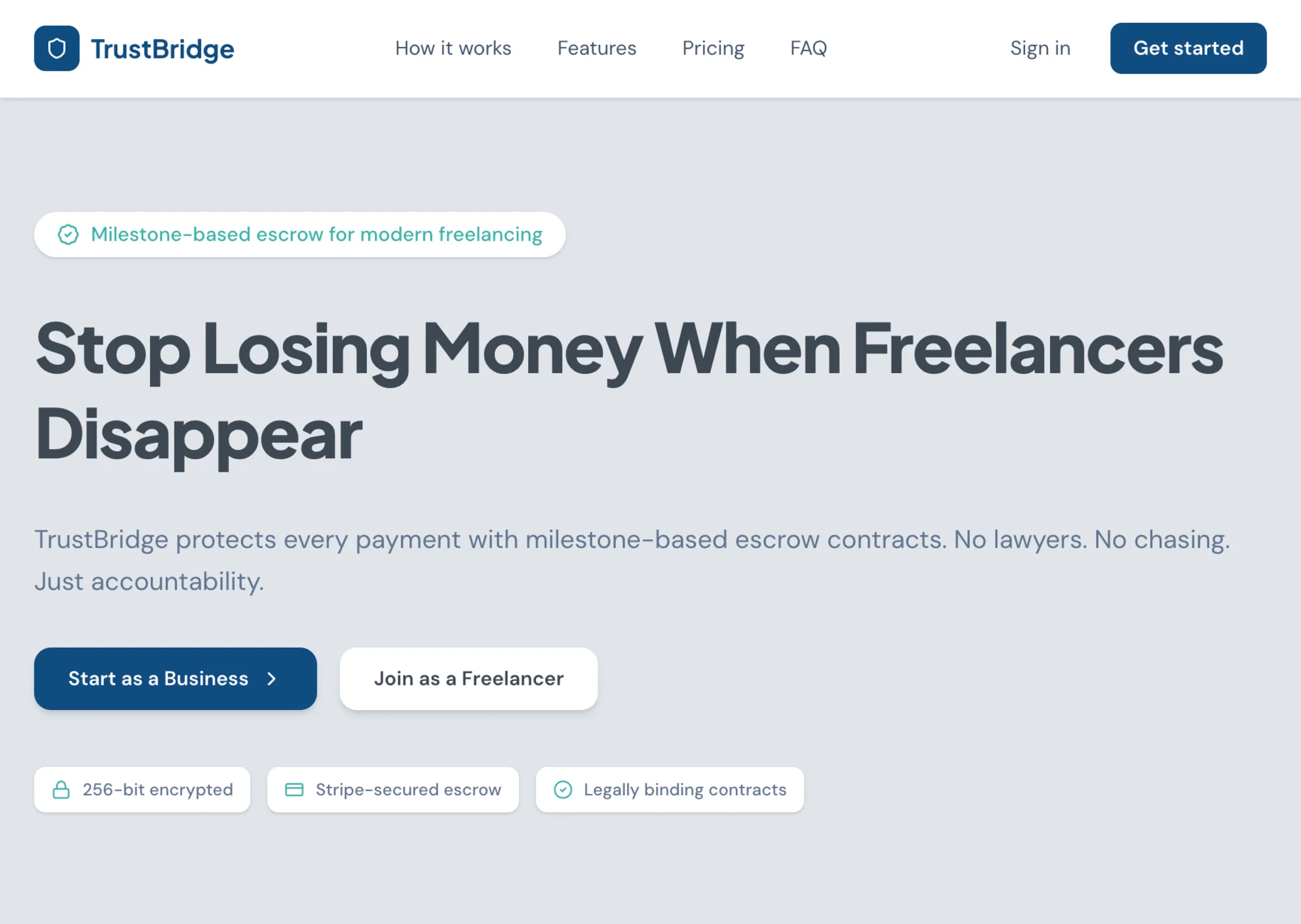
The central design challenge was credibility. A platform handling other people’s money needs to feel secure, transparent, and professional from the first second a visitor lands on it. The headline I arrived at, “Stop Losing Money When Freelancers Disappear,” addresses the business user’s fear directly and immediately. It does not explain the product. It names the problem the product solves.
The hero section establishes the value proposition in one line, “Milestone-based escrow for modern freelancing,” and gives both user types an immediate entry point: Start as a Business, Join as a Freelancer. Below it, three trust signals are placed before any further explanation: 256-bit encryption, Stripe-secured escrow, legally binding contracts.
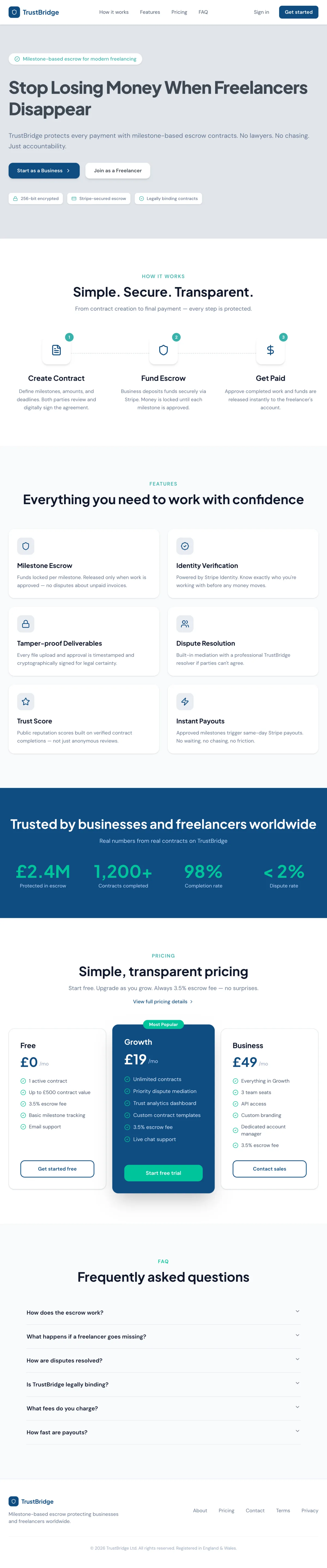
The How It Works section reduces a complex financial and legal process to three steps: Create Contract, Fund Escrow, Get Paid. This is deliberate compression. The goal is to make the product feel simple before the features section adds depth.
The features grid covers the six capabilities that address the most common failure points in freelance engagements: Milestone Escrow, Identity Verification, Tamper-proof Deliverables, Dispute Resolution, Trust Score, and Instant Payouts. Each is framed around the user’s concern rather than the technical implementation.
The social proof section uses specific numbers: 2.4 million pounds protected in escrow, 1,200 contracts completed, 98% completion rate, less than 2% dispute rate. These figures are designed to answer the unspoken question every new user has: does this actually work?
The pricing structure, Free, Growth at 19 pounds per month, Business at 49 pounds per month, is tiered to match the scale of the user, with the Growth tier highlighted as most popular. The escrow fee model is surfaced clearly in the pricing section rather than buried, because transparency about fees is itself a trust signal for a platform built around financial accountability.
WHAT THIS PROJECT DEMONSTRATES
TrustBridge is a product I designed because I identified a real gap in how freelancers and businesses transact, and I had the skills to respond to it. The design work required thinking across multiple layers simultaneously: the emotional journey of a user who has been burned before and needs to be reassured, the information architecture of a two-sided platform serving different user types, and the visual language of a fintech product where trust is the entire proposition.
It is also the project where I most clearly demonstrate product thinking as distinct from execution. I was not given a brief. I found the problem, defined the product, and designed the solution.
Self-initiated concept | UI/UX, Product Design, Marketing Site